THE LITERARY LIBRARY
Criticism, craft material, genre rules, and cited research are available to every book. Retrieval results retain source and applicability. They advise agents; they do not define fictional truth.
LOCAL STORY KNOWLEDGE / VISIBLE PRODUCTION
A novel contains more than sentences. It contains private knowledge, false beliefs, physical limits, promises, injuries, clues, causal debts, and decisions that have not reached the page yet. NovelGraph records that underlying structure, then lets the author decide what the narrative reveals.
git clone https://github.com/CSandbatch/novelgraph.gitThe npm package names are reserved in the release plan but are not published yet. Source setup is available now.
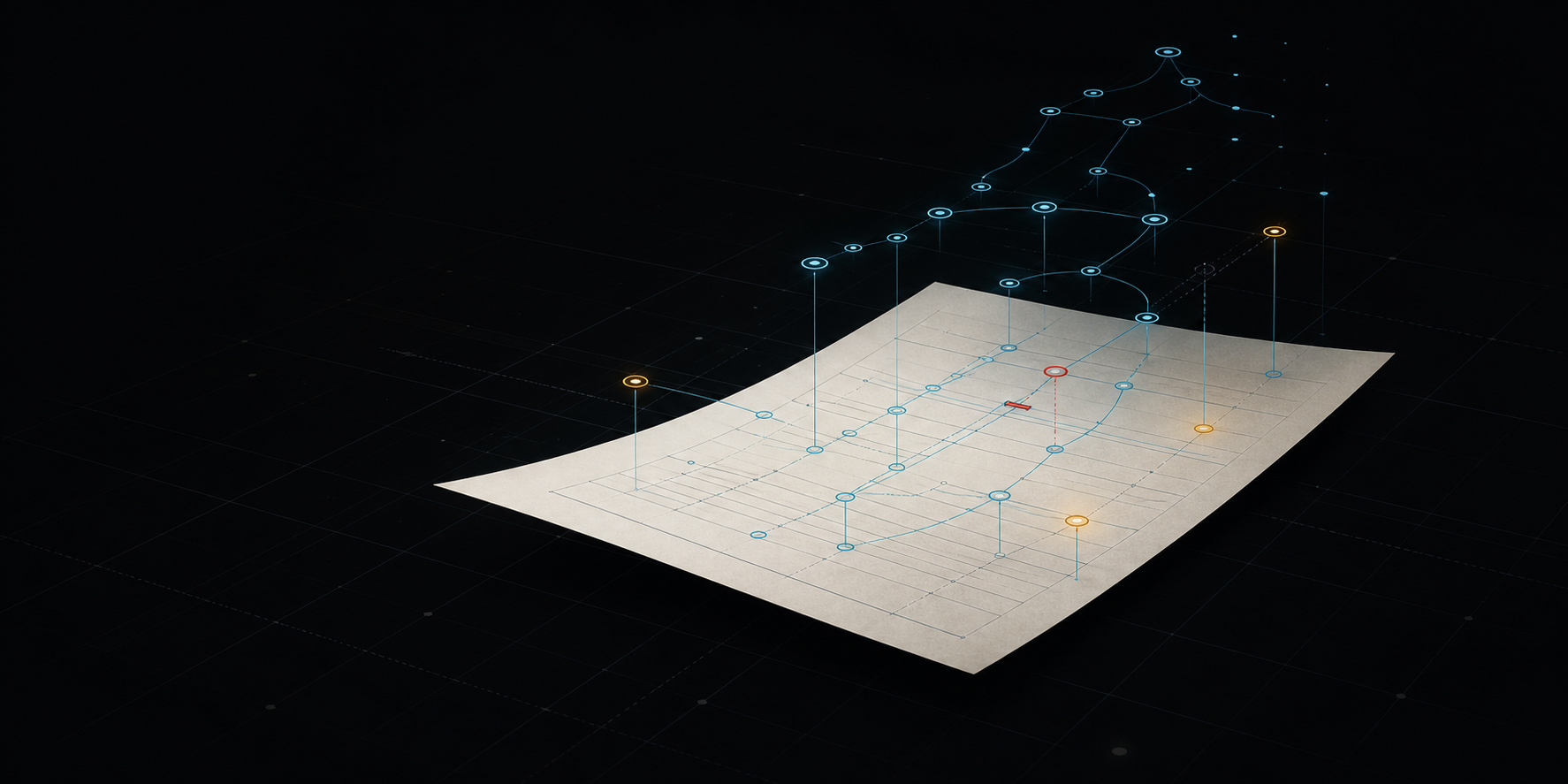
BEGIN WITH THE AUTHOR
NovelGraph first asks what the book must do. Sol conducts that exchange one consequential question at a time. The questions concern the promised reader experience, the engine that can keep producing scenes, the protagonist's costly contradiction, the obligations created by genre, and the pressure an ending must release.
The system marks each extracted idea by source. An explicit author statement differs from an agent inference. A passage retrieved from literary criticism remains guidance. A proposed turn belongs to the scratchpad until the author accepts it. The interface keeps those distinctions visible because a plausible suggestion should not acquire authority merely by surviving several prompts.
When the conversation has enough shape, Terra produces three candidate thrusts. Core follows the author's stated direction. Stretch intensifies one pressure already present. Wild tests a neighboring book that might expose what the author does or does not want. The author can combine, reject, or rewrite them. Approval creates the Story Charter. No production job begins before that decision.

Criticism, craft material, genre rules, and cited research are available to every book. Retrieval results retain source and applicability. They advise agents; they do not define fictional truth.
A book may link to a larger continuity. It selects the characters, events, places, and rules it needs. A contradiction creates an impact review instead of a silent override.
Each book carries enough state to stand alone: charter, character state, chronology, obligations, clues, knowledge boundaries, revisions, and accepted decisions.
Agents record hypotheses, doubts, contradictions, alternatives, and rejected paths. Sol compacts them into a handoff dossier while the original entries remain available for audit.
Scenes and chapters expose selected parts of the graph. A prose edit may propose a canon change, but a paragraph cannot quietly rewrite the facts that govern every other scene.
Creative commitments cross into canon through approval. Operational facts such as timestamps and job status record themselves. The distinction keeps automation useful without granting it authorship.
SOL / TERRA / LUNA
Sol owns the conversational thread. It decides which question should come next, assembles the context dossier, routes bounded work, watches the budget, and presents decisions to the author. It cannot approve its own proposal.
Terra receives the material needed for structural judgment: the current charter, selected story facts, cited literary guidance, unresolved questions, and the relevant scratchpad history. It examines genre contracts, character engines, thematic pressure, alternative solutions, and the consequences of changing an accepted premise.
Luna receives narrower tasks. It extracts entities from a turn, links a statement to its source, compares two candidate outlines, retrieves craft material, checks a timeline, or formats an audit artifact. A smaller assignment also receives a smaller context surface.
Every handoff states what the agent may read, what it may write, and whether its output is reader-visible, solution-authorized, or author-only. Mystery drafting agents cannot inspect the culprit merely because the culprit exists in the same database.

A CLOCK WITHOUT HANDS / SEE THE DIFFERENCE
The author wants retrospective recognition: the reader should understand that the silent clock testified before any person did.
The approved thrust makes testimony compete with bounded physical evidence. Mara must learn that an unreliable device can still disprove one specific claim.
The clock, the garden camera gap, and Elias's midnight statement enter separate records with reliability, visibility, first appearance, and true meaning.
Drafting and solver agents see that the clock stopped at 11:43. They do not see the sealed reconstruction or the future deduction.
The fairness check blocks closure if the final explanation uses a clue that appeared too late or if another solution fits the disclosed evidence equally well.
A proposed repair changes the locked timeline. NovelGraph shows the affected scenes and audits before the author accepts or rejects the retcon.
THE PRODUCTION LINE
After charter approval, the selected genre pack establishes its planning questions, state extensions, reader expectations, and audits. Research enters through a hardened service and remains untrusted until the author admits it. Outlining and scene planning create typed artifacts. Drafting operates on a reader-safe projection. Deterministic validation runs before interpretive review.
Graph proposals identify what changed in the fictional world. Continuity and genre audits test those claims. Reader personas report reactions with evidence instead of producing a cloud of unranked opinion. Revision creates another immutable surface. The cycle repeats until every hard obligation is resolved, deliberately deferred, or waived with the author's reason.

Literary guidance, optional series canon, book canon, run scratchpads, and manuscript surfaces have different authority.
Sol conducts the interview. Terra reasons about structure. Luna extracts and checks. The author alone approves canon.

Every drafting and review stage leaves artifacts, costs, findings, and approval history in the local project.
WHAT THE AUTHOR CAN INSPECT
A production node does not hand back a paragraph and disappear. Its artifact identifies the input revision, the graph records supplied to it, the literary passages retrieved for the task, the capabilities granted, the model and token count, and the node that requested the work. Sol presents the result beside those records. The author can accept the proposal, reject it, revise it directly, or send a bounded question back through the graph.
That history matters when a later chapter breaks. Suppose a scene places Mara in the archive at 11:50, while an approved timeline still places her on the southbound train until 12:07. The continuity check cites both records. Terra can examine the dramatic purpose of the archive scene and propose several repairs. Luna can list every dependent scene and clue. Sol does not collapse those outputs into a hidden choice. It presents the affected records, estimated rewrite scope, stale audits, and required approval.
Rollback concerns the narrative surface. A retcon concerns accepted story state. Restoring an earlier paragraph does not automatically restore the chronology that once accompanied it; accepting a chronology change does not silently edit every scene that referred to the old time. NovelGraph records both operations and identifies the reconciliation work still due.
COST / STORAGE / CONTROL
Before a run begins, Studio estimates its model use from the selected nodes and context sizes. The author sets a run ceiling and a monthly ceiling. Every completed model call records its usage against those limits. A hard stop leaves the job resumable; it does not convert a budget overrun into an automatic approval. An override is explicit and remains in the event history.
The local database stores canonical records, revisions, jobs, findings, approvals, and artifact metadata. Markdown and JSON exports provide portable inspection and Git-friendly snapshots, but they do not become a second writable authority. Backups checkpoint SQLite's write-ahead log before copying the database. Numbered migrations create a timestamped pre-migration backup and retain the original when a transaction fails.
Optional diagnostics are off until the author turns them on. The allowlist admits coarse runtime facts such as the NovelGraph version, operating-system family, duration bucket, operation name, and error class. The collector rejects manuscript text, prompts, model responses, project names, local paths, research material, credentials, and graph content.
LOCAL BY CONSTRUCTION
Studio binds to the loopback interface. SQLite, manuscript revisions, sealed solutions, research snapshots, and credentials remain inside the selected project directory. The public demo uses a fixed fictional case and writes nothing to a server.
MANUSCRIPTStored in the local NovelGraph project.
CREDENTIALSRead by the local process for selected providers.
RESEARCHRecorded with URL, snapshot, excerpt, date, and admission status.
TELEMETRYOff by default; allowlisted diagnostics exclude creative content.
ALPHA MEANS SPECIFIC THINGS
SQLite story state, revisions, obligations, fair-play mystery records, reader projections, durable DAG jobs, budgets, approvals, closure reports, and the conversational discovery foundation.
Provider-backed execution for every discovery and production node, richer graph editing, deeper series reconciliation, and broader genre packs.
NovelGraph does not promise an unattended publishable novel, prove who wrote a passage, replace legal or forensic expertise, or make an aesthetic decision final without the author.
START WITH THE QUESTION THAT GOVERNS THE BOOK