Revision, retcon, and rollback
NovelGraph separates narrative surface from approved story state. A chapter edit changes the current chapter content, creates a row in revisions, and records an author event. A retcon changes an established fact or commitment and therefore needs an approval decision before it becomes canon. A rollback restores earlier chapter content; it does not erase the event history.
Classify the proposed change
Section titled “Classify the proposed change”| Change | Required authority | Gate |
|---|---|---|
| Typo, wording, or local continuity repair | Author edit | Save a revision, inspect the diff, rerun relevant audit |
| Outline or scene-plan change | Author decision | Approval kind outline-change, then rerun dependent work |
| Identity, death, major arc, or established fact change | Author decision | Approval kind character-major-change or canon-retcon, rationale, then re-audit |
| Research admission | Author decision | Approval kind research-admission; retain source and rationale |
| Hard-gate exception | Author decision | Approval kind gate-waiver; closure records the waiver as a warning |
Agents can propose a change through canon:propose or a review finding. They cannot silently promote the proposal. The core schema carries approval kinds, but the current Studio HTTP surface exposes approval resolution, not a generic approval-creation route. Do not describe a review-card click or an agent completion as approval unless the approval record exists.
Save a chapter revision
Section titled “Save a chapter revision”The Studio editor sends a PATCH to /api/v1/chapters/:chapterId. The payload accepts an optional title, optional contentMarkdown, and a non-empty reason:
curl -X PATCH http://127.0.0.1:4567/api/v1/chapters/<chapter-id> \ -H 'content-type: application/json' \ -d '{"contentMarkdown":"Updated chapter text","reason":"Repair stopped-clock testimony"}'The store operation is transactional: it saves the new content in revisions, updates the chapter, and records chapter.updated. GET /api/v1/books/<book-id> returns current chapters plus revision metadata (id, chapter, reason, actor, and timestamp). The current route does not return revision content.
After a canon-affecting change:
- Capture the current book and the approval rationale.
- Apply the approved chapter or graph change with a specific reason.
- Mark dependent audit results stale when the owning service supports invalidation; a mystery policy, solution, or typed mystery record change does this in
MysteryEngine. - Run validation and the relevant audit again.
- Resolve the originating finding only after the re-audit shows that the issue is gone.
- Check
/api/v1/books/<book-id>/closurebefore export.
Roll back safely
Section titled “Roll back safely”The core store has StudioStore.restoreRevision(revisionId). It updates the chapter from the selected revision and records revision.restored with actor author. It does not delete old rows. It also does not create a new revisions row, and the current HTTP server does not expose this method as a restore route.
Therefore the supported operational boundary today is:
- use the editor or
PATCHroute to apply a known-good chapter body with a reason such asRollback to revision <id>; - preserve the original database backup before any direct recovery work;
- do not edit
studio.sqliteby hand or invent/restoreAPI calls; - rerun audits and closure after the rollback.
If the only copy of the desired old content is inside SQLite, stop Studio and use a read-only SQLite inspection tool to retrieve revisions.content_markdown. Keep the original .novelgraph/studio.sqlite unchanged, write the recovered text to a controlled local file, then apply it through the normal chapter update path. A database-level restore is a recovery operation, not a canon approval.
For an interrupted workflow, cancel the job and inspect its durable event log:
curl -X POST http://127.0.0.1:4567/api/v1/jobs/<job-id>/cancelcurl http://127.0.0.1:4567/api/v1/jobs/<job-id>After resolving the external cause, resume only a blocked or failed job:
curl -X POST http://127.0.0.1:4567/api/v1/jobs/<job-id>/resumeDo not start a duplicate run with a new idempotency key merely because a worker stopped. Use a new key only when the prior run is intentionally abandoned and the new run has a distinct reason.
Failure states
Section titled “Failure states”| State | Meaning | Next action |
|---|---|---|
Capability denied | The caller lacks the node’s declared capability | Narrow or correct the worker capability set; do not grant solution access as a shortcut |
Job cancellation was requested | The job cannot accept more node work | Inspect events, then resume after the cause is resolved |
Node is not pending or Node is not running | A duplicate or out-of-order transition was attempted | Read job state and use the durable node status |
validation_runs.status = stale | A mystery policy, solution, or typed record changed after validation | Run /mystery/validate and inspect new findings |
Closure publishable: false | A critical finding or unresolved hard obligation remains | Resolve, defer with a target, or waive with rationale; then recheck closure |
| Missing chapter content for recovery | The public API exposes revision metadata only | Stop, preserve the database, recover through a read-only local SQLite inspection path |
Canonical invalidation diagram
Section titled “Canonical invalidation diagram”Open the rendered revision-invalidation diagram · Read the canonical Mermaid source
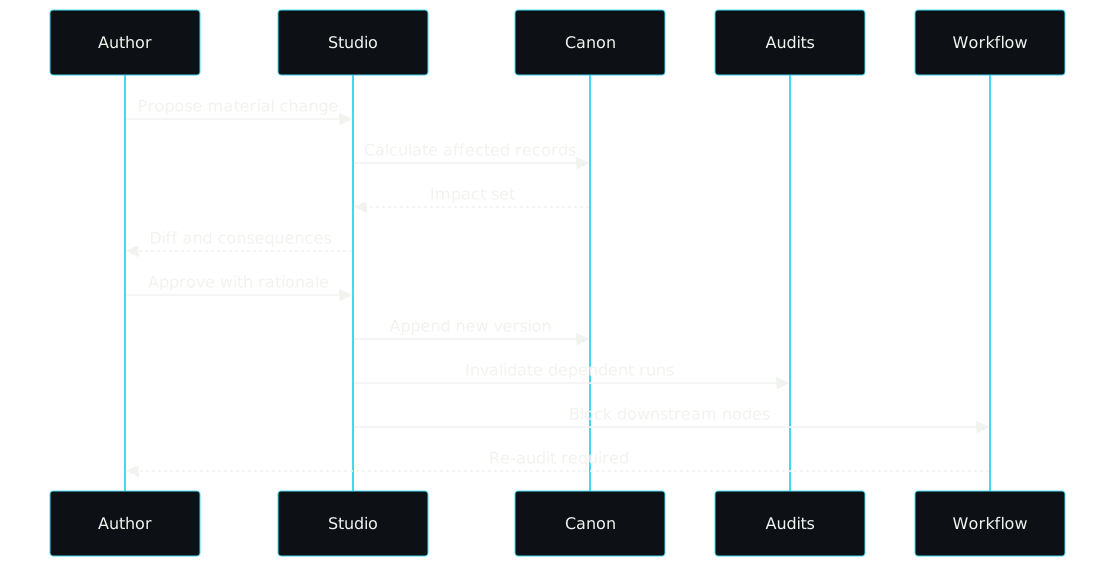
Accessible equivalent: a proposed change enters Studio; the system calculates affected records; the user reviews the diff and consequences; approval appends the new version; dependent audits become stale; downstream workflow nodes block until re-audit.